
HealthTech, Workforce Vitality
Industry
NewU
Company
Onboarding and activation, Rebuilt
THE PROBLEM
Problem? Admins experienced a lack of progress across early actions, leading to information overload and uncertainty about what to do next. As a result, initial setup felt overwhelming rather than progressive, causing many admins to abandon the platform before establishing a repeatable workflow or perceiving sustained value.
How might we design the admin portal so that an admin’s very first actions: setting up initiatives, launching services, and inviting employees don’t feel like one-off setup tasks, but instead form the foundation of a habit-forming workflow that continuously reinforces value, builds confidence, and naturally pulls them back into the platform over time?
HYPOTHESIS
"If we redesign NewU’s onboarding to actively guide new HR admins through key setup actions,creating initiatives, launching PMO services, and enabling employee access, clients will reach first value faster, leading to higher early activation, deeper engagement, and improved long-term retention.
OUTCOME
Reduced time-to-first-value by ~40% through a streamlined onboarding flow.
Increased admin activation by ~25% by guiding users to high-impact actions early.
Result: Improved 30-day admin retention by ~15–20% after redesign.


Showcase
My Process
Start: Data gathering
I started with one question: Why were admins logging in and then leaving?
The data was clear. New clients signed up, explored briefly, and dropped off before completing key actions. The product worked but it didn’t guide.
To understand why, we focused on a real user: Jane, an HR manager responsible for wellbeing at her company.
Jane wanted to succeed. But each login made it harder. The dashboard showed too many options, no clear starting point, and no sense of progress.
So, like many admins, she closed NewU and postponed action.

Middle: Hypothesis formulation
Instead of adding features, we focused on guidance.
Jane didn’t need more tools: She needed a clear path.
We introduced lightweight in-product guides to reduce overwhelm and help her achieve early wins. Confidence improved, but it wasn’t enough.
What Jane really needed was structure.
So we redesigned onboarding into clear tracks based on real admin tasks: setting up initiatives, launching PMO services, and enabling employees. Each step built on the last, turning setup from a confusing checklist into a clear journey.
The product stopped asking, “What do you want to do?”
It started saying, “Here’s what to do next and why.”
Userguiding checklist and tour guides
End: The pizazz
By the end of the flow, Jane wasn’t just logged in, she was activated. She had launched her PMO, understood how to run research, and felt confident navigating the system.
With the AI content generator, she could also create initiatives, surveys, and wellbeing content without starting from a blank page. The platform shifted from something she had to figure out into something that actively supported her.
What changed wasn’t just onboarding, it was behavior. Early actions created momentum. Guided setup removed hesitation. AI-assisted creation reduced effort. Engagement turned into retention.
The result was a system that no longer lost admins after first login, but instead carried them forward step by step, combining guidance and intelligence to drive long-term adoption and meaningful organizational impact.

Experiments
We believed admin drop-off wasn't a feature problem—it was a guidance problem. Our core hypothesis: if we transform onboarding from open exploration into a structured, sequential flow, admins will reach first value before losing momentum.
We tested this through three specific bets:
Bet 1
Reduce choices, increase completion. Showing fewer options at each step would lower cognitive load and increase task completion. Result: Validated, completion rates rose when we moved from dashboard-first to guided-first entry.

Bet 2
Sequence matters. Ordering tasks by natural dependency (create initiative → launch service → invite employees) would feel intuitive rather than arbitrary.
Result: Validated, admins who followed the structured track completed 3x more setup actions than those using the previous flow.

Bet 3
AI removes the blank page. Offering generated content starters would reduce hesitation and speed up initiative creation.
Result: Validated, time to first initiative dropped significantly when AI suggestions were introduced.
One early hypothesis didn't hold: we initially believed tooltip-based guidance would be sufficient. Testing showed it helped confidence but didn't change behavior. Admins needed more than hints, they needed a path. This insight drove the shift to structured onboarding tracks.
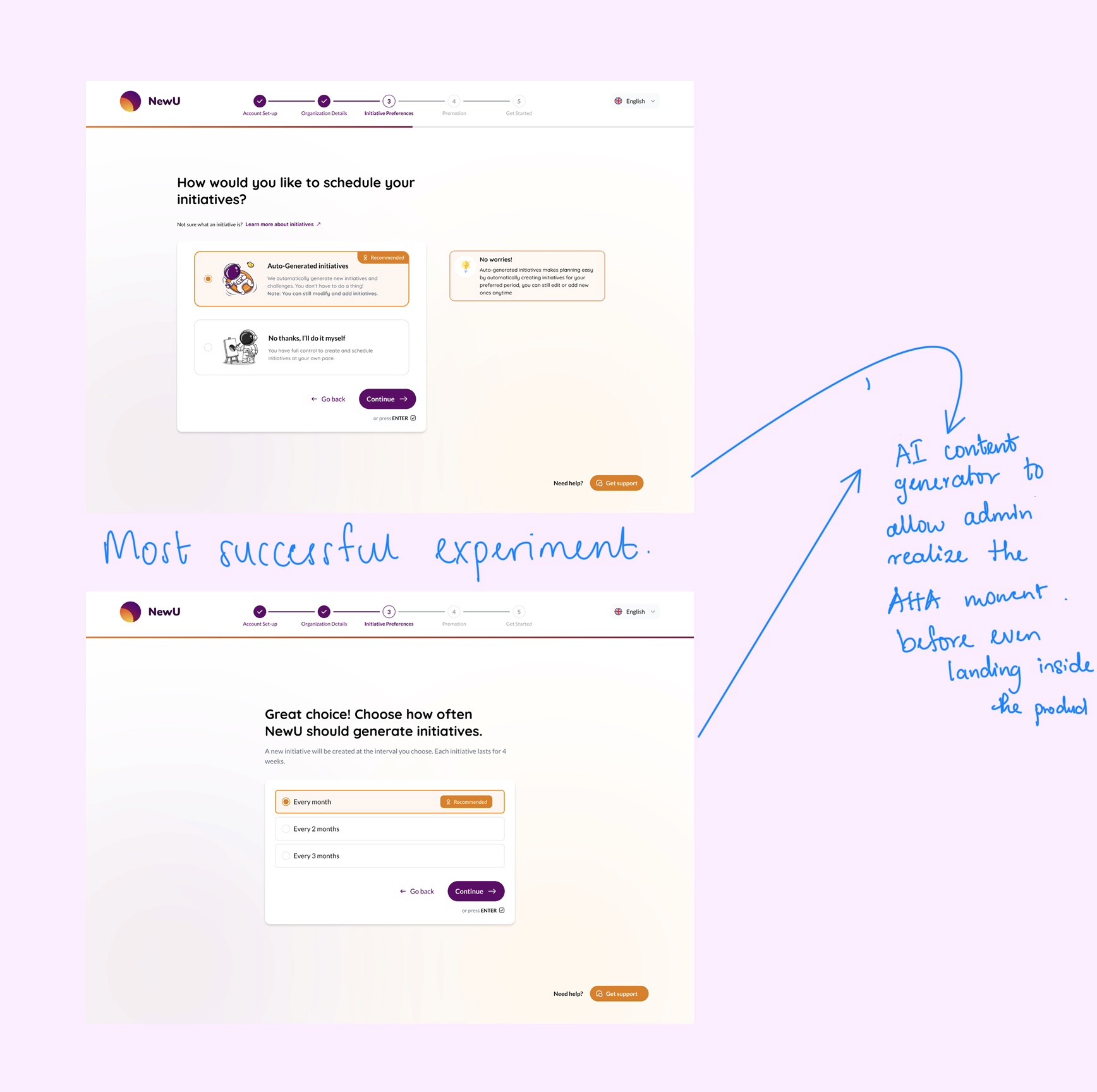
Business onboarding & AI generated content builder
Reflection
Growth doesn’t come from more features, it comes from guiding users to the right actions at the right time.
Onboarding is not a handoff; it’s the first retention system. Data without prioritization creates noise, not insight.
The fastest way to increase retention is to shorten time-to-first value.
Admin products succeed when they reduce cognitive load and increase confidence.
Dashboards should drive decisions, not just display metrics. Early behavior is the strongest predictor of long-term adoption.
Designing for growth means engineering behavior, not persuading users.
When insight and action live together, engagement compounds. The best growth wins come from system-level changes, not surface polish.
Onboarding and activation, Rebuilt
THE PROBLEM
How might we design the admin portal so that an admin’s very first actions: setting up initiatives, launching services, and inviting employees don’t feel like one-off setup tasks, but instead form the foundation of a habit-forming workflow that continuously reinforces value, builds confidence, and naturally pulls them back into the platform over time?
HYPOTHESIS
If we redesign NewU’s onboarding to actively guide new HR admins through key setup actions,creating initiatives, launching PMO services, and enabling employee access, clients will reach first value faster, leading to higher early activation, deeper engagement, and improved long-term retention.
OUTCOME
Reduced time-to-first-value by ~40% through a streamlined onboarding flow.
Increased admin activation by ~25% by guiding users to high-impact actions early.
Result: Improved 30-day admin retention by ~15–20% after redesign..
HealthTech, Workforce Vitality
Industry
NewU
Company
old view
Redesigned
My role
Product design manager, I led the end-to-end processes
What I did
Led the end-to-end onboarding redesign from MVP to a full pre-onboarding system.
Built the first onboarding MVP using UserGuiding, including guided checklists and a lightweight knowledge base.
Collaborated with our CEO and design team to create HRU Onboarding, replacing UserGuiding with a more scalable setup tool.
Redesigned the onboarding into segmented, activation-focused steps to reduce overwhelm and drive higher completion.
Worked closely with vitality coaches to align onboarding with real client workflows and improve time-to-activation.
Onboarding and activation, Rebuilt
THE PROBLEM
How might we design the admin portal so that an admin’s very first actions: setting up initiatives, launching services, and inviting employees don’t feel like one-off setup tasks, but instead form the foundation of a habit-forming workflow that continuously reinforces value, builds confidence, and naturally pulls them back into the platform over time?
HealthTech, Workforce Vitality
Industry
NewU
Company
OUTCOME
Reduced time-to-first-value by ~40% through a streamlined onboarding flow.
Increased admin activation by ~25% by guiding users to high-impact actions early.
Result: Improved 30-day admin retention by ~15–20% after redesign..
old view
Redesigned
My role
Product design manager, I led the end to end processes
What I did
Led the end-to-end onboarding redesign from MVP to a full pre-onboarding system.
Built the first onboarding MVP using UserGuiding, including guided checklists and a lightweight knowledge base.
Collaborated with our CEO and design team to create HRU Onboarding, replacing UserGuiding with a more scalable setup tool.
Redesigned the onboarding into segmented, activation-focused steps to reduce overwhelm and drive higher completion.
Worked closely with vitality coaches to align onboarding with real client workflows and improve time-to-activation.